The Rented Daylight: Reading a Fair's Lighting Before You Buy
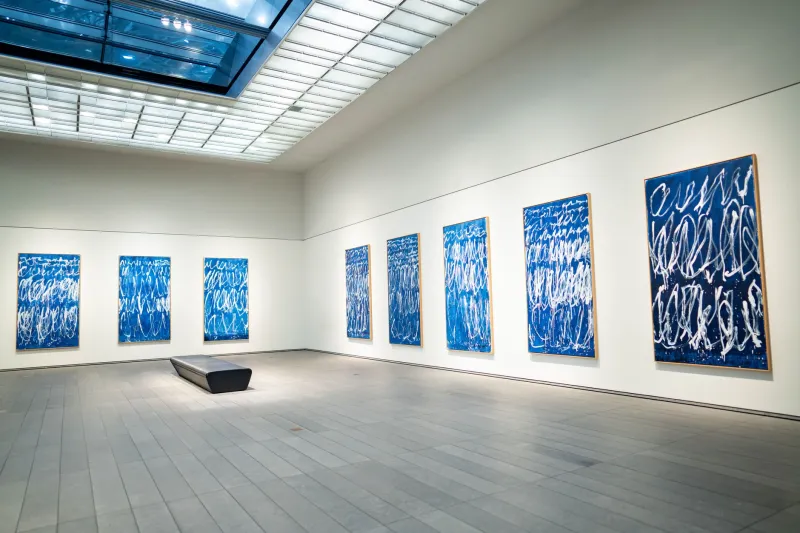
At a London art fair, light is part of the offer. The booth has been planned as a small theatre of attention, with rigs, wall tones and sightlines arranged to make work feel resolved. For the collector, the task is not to distrust that theatre but to read it. A painting seen under a fair's rented daylight is not necessarily being misrepresented; it is being presented. The useful question is what remains true when the stand is dismantled and the work enters a home.
The Rig Is a Claim, Not a Constant
Galleries speak about lighting in technical terms because lighting is a technical instrument. Colour temperature, usually expressed in kelvin, governs whether a stand feels warm or cool. A warm-white beam in the region of 3000K will lend depth to oil paint and flatter certain earth pigments; a cooler, brighter source can make works on paper feel crisp and contemporary. Colour rendering matters too. A high CRI source allows subtle differentiations of hue to survive; a poorer one can flatten them. Beam angle and diffusion decide whether a surface is washed evenly or picked out with theatre.
None of this is inherently dishonest. A dealer has a short window in which to show an object at its best, and lighting is one of the few variables fully under their control. But collectors should understand that the rig is a claim about the work. It says: this is how the painting wants to be seen. Your visit is an opportunity to test that claim against other conditions.
Why 11am and 4pm Are Different Works
Fair lighting is rarely stable. In tented fairs, daylight enters through translucent fabric and changes with cloud cover; in historic buildings, windows and ceilings introduce their own rhythm. A stand that feels calm at eleven may feel warmer, dimmer or more contrasty by late afternoon, when artificial light carries more of the burden. Crowds alter the experience as well: bodies absorb light, cast shadows and change the ambient temperature of a booth.
This is why a single viewing is a poor basis for a purchase. A painting that appears rich and resolved in the morning can seem chalky under a different mix; a work on paper that looks brilliantly white at midday may reveal a warmer paper tone when the daylight fades. Serious collectors build a second pass into the day. Return to the stand at a different hour, stand in a different position, and look at the work from the aisle as well as from the viewing line. The object should hold up in both registers.
White Walls and Their Undertones
White walls are not a neutral absence of colour. Warm whites, cool whites and off-whites each shift the apparent hue of adjacent work. A warm wall can make a cool blue feel cooler; a cool wall can make an ivory ground look yellowed. Shadow matters as well. A deep booth with a single spot can give a small painting an intensity it will not possess in a domestic room, while a flat wash of light can make a textured surface look bland.
Collectors should therefore look at the edges of a work as carefully as the centre. Does the wall tone seem to push the painting in a particular direction? Does the frame cast a shadow that hides a signature or a condition issue? If the gallery has a secondary viewing area, ask to see the work there. If not, ask whether the work can be moved slightly, or whether the stand can be dimmed for a moment. A reasonable dealer will understand the request; it signals that you are buying with your eyes rather than the room's atmosphere.
What Flattering Light Can Conceal
Lighting can reveal, but it can also soften. A raking light, angled across a surface, will expose craquelure, retouching, uneven varnish and the slight lifts that tell of old restoration. A flat, warm wash can do the opposite, blending imperfections into the general glow. Works on paper are especially vulnerable: a bright source may make foxing or discolouration less obvious, while glazing can introduce reflections that mask the surface entirely.
This is not an accusation against fair practice. Condition reports exist precisely because surfaces are complicated. But the collector should ask to see the work under more than one light. A UV torch can help identify later retouching or varnish; a raking light can show surface behaviour. If the gallery cannot provide either on the stand, ask for a condition report prepared under neutral conditions and for high-resolution images made in daylight. The point is not to manufacture suspicion but to establish a fuller record before money changes hands.
Questions to Put to the Stand
The best questions are specific and polite. Ask whether the work can be viewed under neutral or natural light, even briefly. Ask what colour temperature the stand is using and whether the work has been lit continuously during the fair. Ask for a condition report that mentions surface, frame and glazing, and for images taken outside the fair's lighting. Ask whether the price includes the frame or any specialist light, and whether the gallery offers an approval period at home. If the work is on paper, ask about UV-filtering glazing and whether the current frame is sealed.
It is also worth asking how the work has been stored and whether it has been shown before. A painting that has spent years in a stable private collection may behave differently from one that has travelled repeatedly. These are collecting questions, not cross-examination. A good dealer will have answers, and the answers will tell you as much as the lighting does.
A Practical Protocol
Walk the fair once without buying. Note the stands that interest you, the hour and the light. Return later, ideally after the crowd has shifted and the daylight has changed. Step back to the aisle, then close to the surface. Use your hand to shade the work if glare is interfering, and ask for the stand to be dimmed if that is possible. Compare the work with others nearby: a colour that seems extraordinary in isolation may reveal its true register beside a cooler or warmer neighbour. Keep notes on your phone, including the time and the conditions. By the final day, you should be buying the object you have seen repeatedly, not the booth you first walked into.
Fair light is borrowed light. It is designed to flatter, and often it succeeds. The collector's discipline is to enjoy the effect without mistaking it for the object's permanent character. Buy the painting, the drawing or the photograph that still holds your attention when the rig is switched off and the white walls come down.