The Sit-Down Dividend: Stamina, Status and the Art of Resting at a London Fair
London fair week rewards the walker and punishes the wanderer. The aisles are long, the lighting is relentless and the conversations are cumulative. Yet the most useful piece of furniture in any fair is rarely listed on the floor plan. A bench, a stool, a café corner: these are not incidental comforts. They are instruments of judgment, places where the eye resets and the mind catches up with the wallet.
The Geography of a Chair
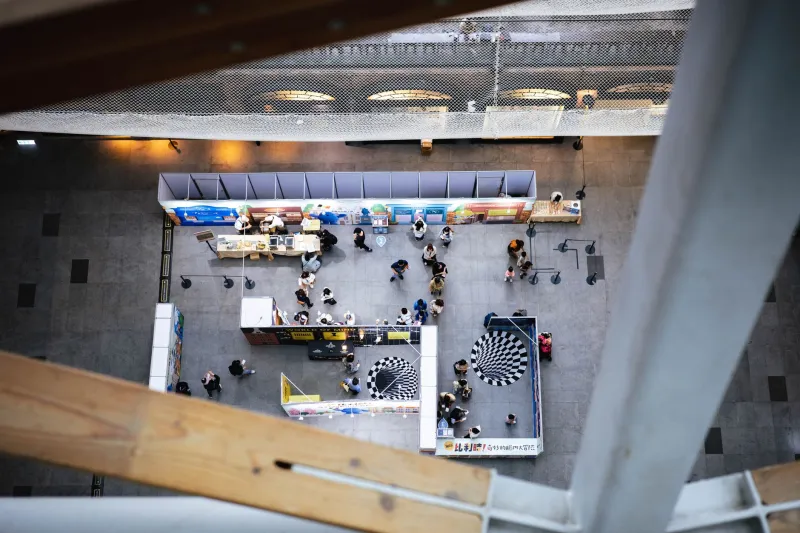
Seating at an art fair is never neutral. Where a fair places its benches tells you what it expects of its visitors. A row of chairs facing a large-scale installation invites contemplation; a cluster of stools beside a coffee counter invites transaction and gossip; a quiet banquette at the edge of a booth invites a longer conversation about provenance. Experienced collectors read these arrangements quickly. They know that the best seat is not always the most comfortable one. It is the one that allows a view of both the work and the room.
At the Business Design Centre, the mezzanine and café areas perform a useful double duty: they offer relief from the carpeted intensity of the fair floor while keeping the visitor within earshot of the building's hum. At Somerset House, the courtyards and passageways provide a different kind of pause — outdoor air, a change of light, a chance to separate one wing of the fair from another. These are not merely places to recover. They are places to revise a shortlist.
Stamina as a Collecting Discipline
There is a tendency to treat exhaustion as a badge of commitment. The collector who stays until the final bell, who sees every stand, who never sits down, is imagined to be the serious one. In practice, the opposite is often true. Decision fatigue is expensive. A buyer who is tired will mistake urgency for quality, confuse a persuasive dealer for a convincing argument, or simply stop looking closely at the things that matter.
Budgeting for rest is therefore a collecting discipline, not a concession to age or indolence. A practical plan might divide the day into ninety-minute blocks, with a deliberate pause between each. The pause need not be long. Ten minutes on a bench with a notebook can be enough to separate the work that has stayed with you from the work that merely made an impression at the time. A glass of water and a change of posture can do more for your eye than another twenty stands.
Footwear matters, but so does timing. The middle of the afternoon is when fair floors become most congested and most repetitive. It is also when the café corners fill with conversations that are worth overhearing and booths become easier to read from a distance. A seated visitor sees the traffic of a stand: who stops, who passes, who returns. That pattern is often more revealing than the price list.
The Etiquette of Occupying a Seat
There is a quiet etiquette to resting at a fair. The first rule is not to camp. A bench is a shared resource, not a private office. The second is to remain alert to the room. A seated collector who stares at a phone is invisible to dealers and unhelpful to other visitors; a seated collector who watches the floor is still part of the fair's social economy. The third rule is generosity. Offer a seat to someone carrying a heavy bag or a catalogue. It costs nothing and it keeps the room civil.
Conversation should be calibrated to the setting. The café is for debriefing, not for negotiation. A bench in an aisle is for observation, not for a lengthy account of your collecting history. If a dealer approaches while you are resting, be clear about whether you are pausing or buying. A simple phrase — 'I am taking a moment, but I would like to come back to this' — is usually enough. It preserves the relationship and protects your concentration.
Where the Chair Makes the Argument
Some London fairs make seating part of their argument more deliberately than others. The London Art Fair in Islington has long used its café and mezzanine as a social hinge, allowing visitors to move between the bustle of the ground floor and a more reflective view above it. Frieze London, in Regent's Park, relies on its outdoor seating and tented edges to break up the intensity of the main aisles; the best conversations often happen at the boundary between the tent and the park. Masterpiece, at the Royal Hospital Chelsea, turns its courtyard into a kind of open-air salon, where the chair is as much a social marker as a resting place. Photo London at Somerset House uses its courtyards and stairwells to create natural intervals, while 1-54 Contemporary African Art Fair, also at Somerset House, benefits from the building's domestic scale: there are corners that feel like a library rather than a marketplace.
These differences are not trivial. They shape how long visitors stay, how closely they look and how willing they are to return to a stand. A fair that gives its visitors somewhere to sit is a fair that understands the difference between browsing and buying.
A Short Seating Plan for Fair Week
Begin with a deliberate sit within the first hour, before the aisles have absorbed you. Use it to mark three stands on your map and to decide which one you will visit first without distraction. Take a second pause around midday, preferably away from the main café, where the queue is shorter and the view is wider. Use that pause to review any holding conversations and to decide which works you will return to after lunch. Keep a third pause for the final hour. This is the most valuable one: it separates the purchases you are making from the purchases the fair is making for you.
A fair is a test of attention. The chair is not an escape from that test; it is part of how the test is passed. The collector who sits down is not withdrawing from the room. They are letting the room settle, so that the next decision is made with a clearer eye.