After the Crowd: Why London’s Fairs Do Their Best Work at Six
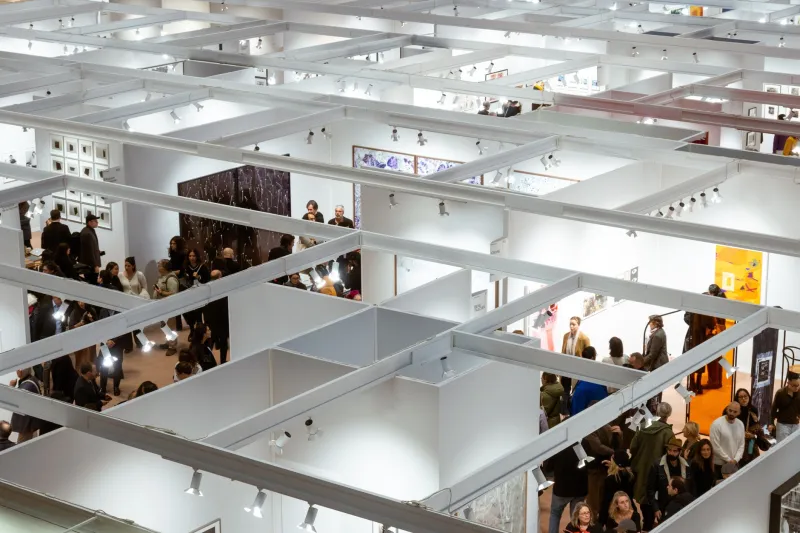
At four o’clock on a winter afternoon, a London art fair can feel like a well-dressed department store: bright, busy and slightly overwhelming. By six, the lighting seems to change. The aisle traffic thins, the conversations slow, and the fair reveals what it is actually for. The 6pm rule is not an official piece of fair etiquette, but it is a useful one. For UK art lovers, the evening programme is no longer a marginal extra. It is often the best reason to go.
The fair as an evening venue
London’s fair calendar has become more crowded and more competitive. Fairs can no longer rely on the simple promise of seeing a lot of art under one roof. They must offer a reason to stay, and increasingly that reason is cultural programming: late openings, artist talks, performances, curator-led walks and the kind of informal encounter that rarely happens at midday. The evening turns a trade event into a public venue. It also changes the audience. The people who come after work are usually there with intent. They have chosen to be there, rather than simply passing through.
This matters for collectors as much as for casual visitors. The daytime fair is excellent for orientation. The evening fair is better for judgment. Once the first rush has gone, it becomes easier to look properly, to return to a work that has stayed in the mind and to ask a gallerist the questions that feel too pedestrian in a crowd. What is the edition size? Is the frame included? Has this work been shown before? These are not trivial details. They are the difference between a pleasant afternoon and a considered purchase.
Mapping the winter evening circuit
For winter 2026, the sensible approach is to treat the fair schedule as an evening diary rather than a daytime obligation. The London Art Fair in Islington has long used late openings to shift the tone of the event, and its evening talks and curator-led walks tend to draw a more focused audience than the daytime rush. The fair’s modern and contemporary mix rewards a slower second look, particularly in the smaller stands where conversations are easier and prices are often more transparent.
Woolwich Contemporary Print Fair has built a following for late sessions that foreground process. Print is a medium that benefits from explanation, and evening demonstrations and artist conversations suit it well. The result is less like a market and more like a studio visit conducted at scale. The Affordable Art Fair’s Art After Dark format, meanwhile, shows what happens when a fair treats the evening as a programme rather than an afterthought. It is a more social model, but it works because it does not pretend that buying art is a purely private act.
Beyond the fair halls, commercial galleries in Mayfair, Fitzrovia and Soho increasingly time their own receptions to coincide with fair weeks. This creates a wider evening circuit, one in which the fair is a starting point rather than the whole evening. For anyone serious about looking, the combination is valuable: the fair provides the breadth, while the gallery receptions provide the quieter, more sustained conversations.
The quieter collector conversation
There is a practical reason why the evening matters. Galleries bring different works to a late opening. Not always, but often. A stand that feels crowded and defensive at noon may become generous at seven. The gallerist has more time, and the collector has more room to be honest about budget. That honesty is not a weakness. It is how good relationships begin.
The 6pm rule also protects against fatigue. Art fairs are exhausting. The eye stops registering after the third or fourth aisle, and the result is a kind of visual indigestion. Arriving late, or returning after a break, resets the attention. A useful pattern is to visit during the day for orientation, leave for an early dinner, and return for the evening programme with a short list of three or four stands. The second visit is usually the more decisive one.
For UK art lovers, this is a welcome development. The fair is still a commercial event, and it should be. But the evening programme gives it a civic and cultural dimension that suits London well. It allows the fair to function as a meeting place, a lecture theatre and a performance space, without losing its commercial purpose. The best evenings do not feel like entertainment bolted on to selling. They feel like the fair remembering that art is a social experience.
Why six is the new centre of gravity
The 6pm rule is not a secret, and it is not a gimmick. It is a way of reading the fair correctly. The daytime crowd sees the most work. The evening crowd has the better conversations. For collectors, that is where the useful information lies. For the simply curious, it is where the fair becomes memorable. Winter 2026 offers a strong test of the idea. Go late, stay longer than you planned, and judge the fair not by how much you saw but by what you learned after the crowd had gone.