The Hum and the Hush: An Acoustic Guide to London Fair Week
The First Ten Minutes Are Never Silent
Arrive at a London art fair before the doors open and the building has a different character. The halls are not silent—they are latent. Extractors hum above the temporary walls, a floor polisher turns somewhere near the café, and the first dealers speak in the lowered voices of people who have not yet had to perform. This is the acoustic baseline against which the rest of the day will be measured. Learn it once and you will hear every subsequent shift in the room.
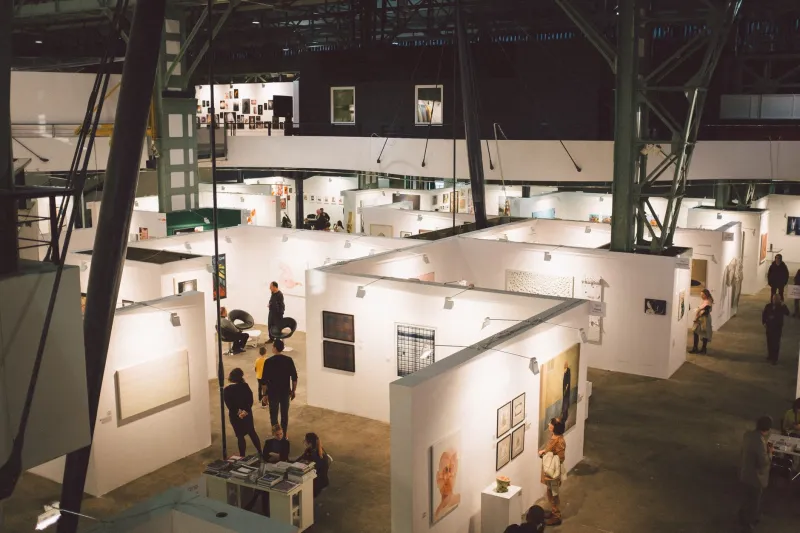
By the time the first visitors cross the threshold, the sound has already begun to organise itself. A fair is never one continuous noise. It is a series of zones, each with its own register: the bright clatter of the entrance, the muffled pockets behind freestanding walls, the dead air beside a heavy curtain, the rising tide around a bar. For the collector, these distinctions are not merely atmospheric. They are practical intelligence. Sound tells you where the crowd is thickest, where conversation is possible, and where a stand has been designed with listening—or its absence—in mind.
Reading the Room by Its Register
The private view is the loudest test. Between six and eight in the evening, a London fair reaches a pitch that is part social, part commercial. The noise is not uniform. It clusters. A stand with a generous aisle and a low plinth will gather a knot of voices; a stand with a narrow entrance and a single wall will keep people moving. Listen for the difference between a crowd that is browsing and a crowd that is buying. Browsing sounds like a slow drift: footsteps, occasional laughter, the soft friction of coats. Buying sounds more concentrated—two or three voices in a tight circle, the dealer’s tone dropping into its lower register, the buyer’s questions arriving in shorter sentences.
Mid-afternoon on a public day has a different acoustics again. The school groups, the couples, the visitors with earbuds—all create a broader, flatter soundscape. This is when you can judge the fair’s circulatory system by ear. If the noise dies abruptly at a corner, there is likely a bottleneck. If it rises steadily along a wall, that is where the eye is being pulled. If you can hear a single booth’s soundtrack from three aisles away, you have found either a confident exhibitor or a careless one.
Where the Quiet Booths Are
Quiet is not the same as empty. Some of the best conversations at a London fair happen on stands that sound softer than their neighbours. Look for carpet rather than bare floor, upholstered benches, heavy drapery, and walls that do not stop short of the ceiling. These are the booths where a dealer has thought about fatigue as well as display. They are also the booths where you can hear the art properly—or at least hear yourself think about it.
A useful rule for fair week: never begin a serious conversation in the loudest third of the hall. If you are considering a work, ask to move to the side of the stand, away from the aisle. Dealers do this instinctively. They know that a price discussion conducted over a nearby video work or a barista’s grinder is a discussion half-lost. The same applies to you. If the stand has no quiet corner, the conversation can wait. There is no obligation to transact at the first meeting.
When the Soundtrack Interferes
Fair-wide music is rare in London, but booth-level sound is not. Video works, audio pieces, and the occasional playlist all bleed into neighbouring stands. The question is not whether sound is present, but whether it is doing what the exhibitor intended. A low ambient piece behind a painting may be a considered frame. The same piece at twice the volume is an imposition. If you find yourself raising your voice to discuss a work, the soundtrack is not helping—it is competing.
Listen also for the unplanned acoustics of the building itself. A hall with a high ceiling and hard surfaces will amplify footfall and turn a modest crowd into a roar by midday. A lower, carpeted space will absorb the same crowd and leave room for conversation. Neither is better in the abstract, but they reward different strategies. In a resonant hall, go early and stay near the walls. In a muffled one, you can afford to linger in the centre.
The Last Hour Rewards the Listener
As the fair thins towards its final hour, the acoustic changes again. The extractors seem louder, the aisles emptier, and the voices that remain are more purposeful. This is often the best time to return to a stand you liked but did not fully understand. The crowd has gone, the music has usually been turned down or off, and the dealer is tired enough to speak plainly. If you have been listening all day, you will know which stands will reward a second visit. The hum has told you where to go; the hush will tell you what to do when you get there.