Three Stops, One Afternoon: A Considered Route Through the Fair
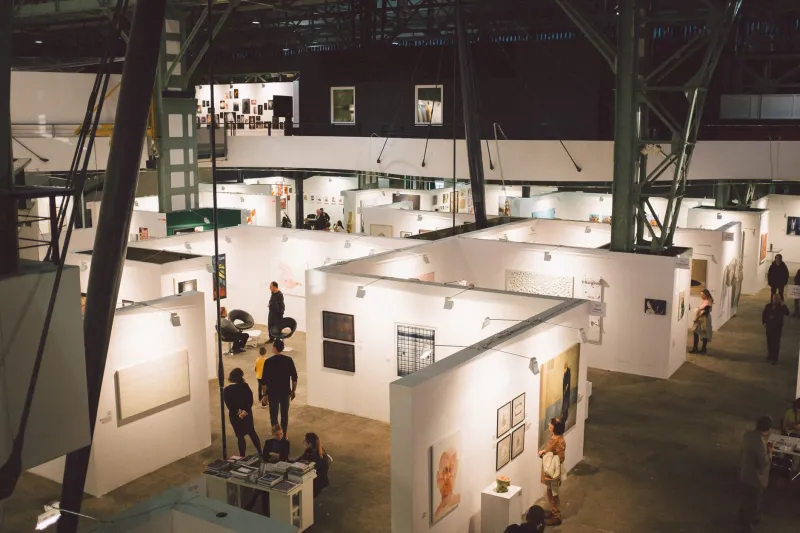
London’s fair calendar is built for the sweep. The floorplan is vast, the aisles are busy, and the closing announcement always seems to arrive early. Yet the collector who tries to see everything often remembers very little. The three-booth rule is a corrective: choose three stands, study them properly, and let the rest of the fair remain a background rather than a checklist.
This is not an argument against curiosity. It is an argument for attention. A fair is at its best when it feels like a series of real encounters—with an artist’s work, with a gallerist’s account of it, and with your own response. Three booths, given enough time, can provide that. Thirty stands, skimmed in an afternoon, rarely do.
Choose three booths before you arrive
The route begins at home, with the fair’s floorplan and exhibitor list. Select one booth from each of three registers: an established gallery whose programme you know, a younger gallery whose artists are less familiar, and a solo or two-artist presentation where the hang is likely to be more concentrated. This gives the afternoon a shape without turning it into a forced march.
It helps to note one reason for each choice. It might be a particular artist, a presentation you have read about, or simply a gallery whose stand has looked thoughtful in previous years. The reason need not be profound. It need only be specific enough to justify the stop. Print the plan or keep it on your phone, but decide the order in advance. Improvisation is valuable later; it is a poor substitute for a plan at the entrance.
The first booth: establish a baseline
Spend at least half an hour at the first stand. Look from the threshold before stepping in. What is the gallery trying to say with the hang? Is there a single artist, a dialogue between two, or a group presentation with a clear argument? Then move closer. Look at surfaces, edges, labels and the way light falls on the work. The first booth is not there to produce a purchase. It is there to establish a baseline for looking.
Ask one open question rather than five closed ones. “Could you tell me how this presentation came together?” is usually enough. The answer will reveal whether the gallerist is interested in the work or merely in the transaction. It will also give you language for the rest of the afternoon.
The second booth: test a hunch
The second stop is where comparison begins. Having seen one stand properly, you will notice more at the next: how another gallery handles scale, framing, or the relationship between painting and sculpture. This is the point at which a hunch can be tested. If a work has held your attention, ask about its materials, its making, and the artist’s recent activity. A useful question is: “What would you want a new viewer to know about this work?”
At this stage, resist the urge to ask everything at once. Price, provenance, condition and delivery can follow. The second booth is for understanding whether the work is as interesting up close as it appeared from the aisle. If it is not, move on without apology. The fair is not a exam, and the gallerist is not keeping score.
The third booth: leave room for surprise
The third booth should be the least predetermined. Keep the slot, but allow the choice to shift if something on the floorplan or in the aisles has caught your eye. A solo presentation is often a good final stop because it asks you to stay with one practice rather than scan a group. Spend the remaining time looking, then ask the question you have been saving.
This is also the moment to take stock. Three booths are enough to reveal patterns in your own taste: a preference for restraint, for particular palettes, for works that reward slow looking. Those patterns are more useful than a bag of catalogues.
Notes without breaking the spell
Note-taking should be light. A small notebook is better than a phone, which invites distraction. Record three things only: the work or booth that held you, the question you asked, and the next step. If you prefer a voice memo, record it after leaving the stand rather than in front of the gallerist. Photograph the label or the booth sign, not the artwork, unless you have permission and the fair’s rules allow it.
The aim is not to build an archive. It is to preserve enough detail that a follow-up email in a few days can be specific rather than vague. “The small painting on the back wall” is less useful than the artist’s name, the title, and the question you discussed.
The follow-up that matters
Within forty-eight hours, write to the gallery. Refer to the conversation, ask for the images or condition report you discussed, and confirm any figures in writing. Keep the note short and courteous. If you are not proceeding, say so politely; gallerists remember good manners. If you are, ask what the next stage looks like.
A fair should not end at the coat check. The three-booth route turns an afternoon into a small, manageable set of relationships. That is a more durable pleasure than having covered every aisle—and, in London’s crowded fair season, a more civilised way to collect.