The Unposted Photograph: Reading Restraint at London Fairs
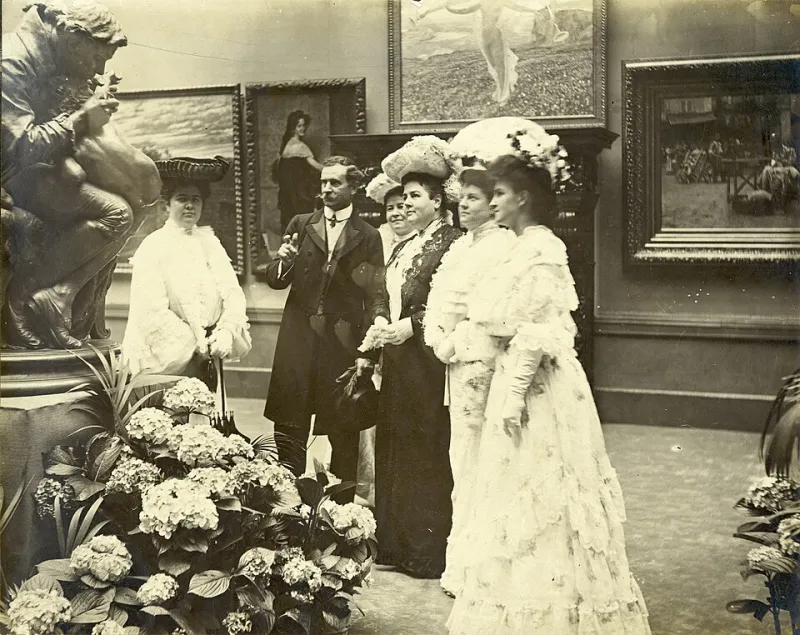
Photo: Jessie Tarbox Beals, Public domain, via Wikimedia Commons
The fair booth is a stage with a very small auditorium. A visitor steps in, a dealer looks up, and a conversation begins before either has spoken. Increasingly, that conversation includes a third party: the phone. In 2026, London fair week is as much a visual economy as a commercial one, and the act of raising a camera — or deliberately leaving it lowered — has become one of the more legible signals in the room. The question is not whether photography belongs at an art fair. It plainly does. The question is what kind of looking the camera encourages, and what the pocket quietly says.
The stand as a designed image
Anyone who has walked the aisles at a London fair knows that stands are composed for the eye, but also for the screen. Sight lines are kept clean, wall labels are positioned to be read at a glance, and the density of works is adjusted so that a single photograph can capture a coherent view. This is not vanity. For galleries, a fair is a shop window that travels further than the aisle. An image posted by a visitor can reach collectors who never attended, and a well-composed shot can carry a stand’s argument into the wider world.
Yet the same design logic creates friction. A stand that photographs beautifully may invite a crowd of phones, and a crowd of phones changes the atmosphere for everyone else. The visitor who arrives to look closely can find the view blocked by someone framing a Reels clip; the dealer who has spent months building a presentation can find it reduced to a single square. The fair is not a museum, and the booth is not a public gallery. It is a temporary commercial room with a host, and the host’s tolerance for being filmed is not unlimited.
Permission is a form of attention
The most useful rule of thumb is also the oldest: ask. In practice, asking does not need to be formal. A nod towards the camera and a query — “May I take a photograph?” — is usually enough. It gives the dealer a chance to say yes, to ask that a work be excluded, or to explain that a particular piece is not to be photographed at all. The response is information. A warm yes suggests a stand that wants its images to circulate. A polite but firm no suggests a work, a consignor or a relationship that requires discretion. Neither response is a judgement on the visitor. Both are part of reading the room.
There are practical reasons for restraint that have little to do with secrecy. Photographs misrepresent. Colour shifts under fair lighting; scale is flattened; texture disappears. A collector who photographs a painting and later reviews it on a phone may be looking at a different object from the one on the wall. Dealers know this, and many will offer a proper image — a high-resolution file, a condition report, a link to a catalogue — if the interest is genuine. The photograph taken in the aisle is a memory aid, not a substitute for looking.
The quiet no-photo corners
Not every stand advertises its boundaries. Some galleries place a small notice; others rely on conversation. In recent fair weeks, a number of exhibitors have created quieter zones where photography is discouraged, often in the deeper part of the stand where works on paper or more fragile pieces are shown. These corners are not secret. They are simply less photogenic by design, and they reward the visitor who slows down.
For collectors, these zones are worth seeking out. A no-photo corner is often where the most considered conversations happen, because the phone is not mediating the encounter. The dealer can speak about provenance, condition and price without the distraction of a lens. The collector can look for longer than a screen allows. If a work is under consideration, this is the moment to ask for the material that will support a decision later: images, documentation, a viewing at the gallery. The camera can wait.
An etiquette guide for fair week
The following points are not rules so much as habits that tend to be appreciated in London’s fair halls and tented aisles.
- Ask before photographing a stand, a work or a dealer. A brief question is enough.
- Keep the phone’s flash off and its shutter sound muted. Neither belongs in a quiet booth.
- Avoid filming other visitors. A fair is a public event, but not everyone wishes to appear in the background of a post.
- Do not photograph wall labels and prices for public circulation without permission. Price information is commercially sensitive, and a label is not a press release.
- Respect a refusal without negotiation. A no is not an invitation to bargain.
- Credit the gallery and the artist if an image is shared. The fair’s own channels usually model the correct form.
- Use the fair’s app or digital catalogue for reference where possible. It is designed for the purpose and reduces the need to photograph labels.
None of this is intended to discourage documentation. A fair is rich with things worth remembering, and a photograph can be a useful prompt. The point is proportion. The phone should serve the looking, not replace it.
What the pocket says
There is a quieter argument for restraint, and it concerns trust. Dealers read behaviour. A visitor who asks before taking a picture, who puts the phone away when the conversation turns to price, and who returns to the stand for a second look is sending a different signal from one who photographs everything and speaks to no one. Neither visitor is necessarily a buyer. But the first is more likely to be remembered, and in a fair week that runs on relationships, being remembered matters.
For collectors, the unposted photograph can be a useful discipline. It forces a distinction between the work that is merely photogenic and the work that holds attention. It also leaves room for the kind of looking that precedes a purchase: the slow return, the second question, the request for a private viewing. In 2026, with fair apps, QR codes and digital catalogues doing much of the reference work, the phone has less reason than ever to stay out. That is precisely why the choice to put it away reads as clearly as it does.
The camera in the booth is not the enemy of the fair. It is one of its instruments. But an instrument played without attention becomes noise. The visitor who knows when to raise it, when to ask, and when to leave it in the pocket is not rejecting the image. They are choosing the longer look — and, often, the better conversation.