The Early Register: Reading a Private View’s First Hour
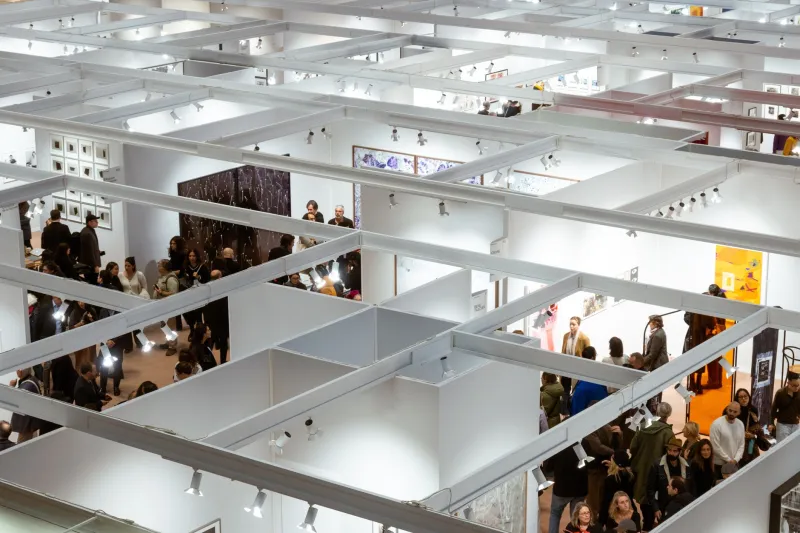
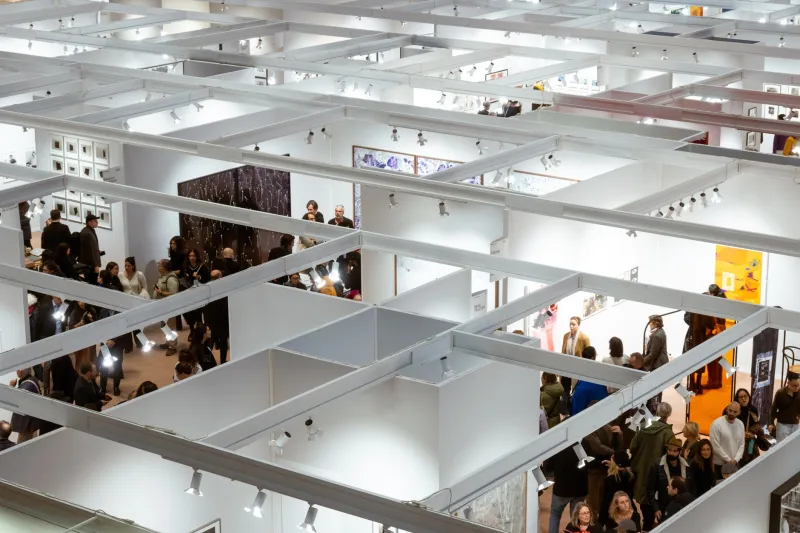
Private views are often remembered for their after-hours: the crowded aisles, the audible deal-making, the tired feet and the final sweep past stands that have already been mentally closed. The first hour tells a different story. Before the room fills, a London art fair exposes its early register — the priorities, loyalties and quiet protocols that will shape the rest of the week. For collectors, the opening hour is less about being seen than about learning how to see.
The Room Before the Room
A private view rarely begins when the doors open. It begins in the fifteen minutes before, when the pavement outside takes on a particular character. At a fair such as Frieze London or Photo London, the earliest arrivals tend to be identifiable not by their clothes but by their pace. They do not drift. They have a route in mind, or at least a first stand to greet. These are often longstanding clients, institutional patrons, curators with a specific research interest, artists represented on the floor and dealers from other galleries paying professional respects. The social crowd arrives later; the first hour belongs to the room’s working population.
This is useful to understand because the early hour is not simply a quieter version of the evening. It is a different fair. Stand staff are still in presentation mode rather than crowd-control mode. Directors are visible. Conversations can be unhurried. A collector who arrives early is not competing for attention so much as observing how attention is distributed when there is still enough of it to go round.
Who Comes First, and Why It Matters
Watch the door for ten minutes and a hierarchy emerges. The first arrivals are often greeted by name, sometimes before the cloakroom ticket is pocketed. A dealer may step out from behind the desk, touch a shoulder, exchange a few words that are clearly continuations of a longer conversation. These are not necessarily the biggest spenders in the room. They are the relationships that have been tended.
The second wave tends to include collectors with lists, advisers moving briskly between stands and artists making brief appearances before the social programme begins. By the time the third wave arrives — the wider invitation list, the curious, the well-dressed and the well-connected — the early register has already been set. Stand layouts have been adjusted, holds have been noted, and the first round of serious questions has been asked and answered.
For the collector, the lesson is not to decode status for its own sake. It is to recognise that the first hour reveals which conversations a fair considers foundational. If a dealer’s first greetings are to curators rather than buyers, that is information. If an artist is present and being introduced quietly to selected visitors, that is information too. The early room is a map of intent.
Dealer Attention as a Diagnostic
Dealer attention shifts measurably across the evening. In the first hour, it is still possible to ask a slow question and receive a considered answer. A director may talk through a work’s provenance, its exhibition history or the reason it was held back for the fair. Later, the same conversation may be reduced to a nod and a promise to follow up. This is not rudeness; it is arithmetic. The first hour is when the arithmetic is still generous.
There is an etiquette to using that attention well. Arrive with a small number of genuine questions rather than a general request for a tour. If you are interested in a work, ask directly but without performance. If you are not, say so gracefully and move on. Dealers remember the collector who took twenty minutes of undivided attention and then vanished as clearly as they remember the one who bought. The early hour is a good time to be precise.
It is also the hour in which to observe how a stand handles its own hierarchy. Who is invited to sit? Who is taken to the back room? Who is introduced to the artist? These small choreographies are rarely accidental. They show how a gallery ranks its relationships and what kind of collector it is cultivating. A stand that greets everyone with the same warmth may be admirable, but a stand that greets everyone identically may also be revealing that it has not yet decided whom it is speaking to.
The Etiquette of Arriving Early
Arriving early is not the same as arriving first. The collector who appears before the doors are properly open, or who requires attention before the stand has finished its final adjustments, is not early so much as premature. The useful window is usually the first thirty to forty-five minutes after the official opening: enough time for the room to settle, but before the aisle traffic thickens.
Dress with the room in mind, but do not overdress the occasion. London private views are formal enough to reward care and relaxed enough to punish costume. Carry fewer things than you think you need. A coat, a phone and a small notebook are sufficient. If you are offered a drink, take it only if you intend to stay long enough to finish it. A glass in hand is not a credential.
Above all, do not monopolise. The first hour is when dealers are most visible and most in demand. A short, well-judged conversation is a better investment than a long one that keeps a director from greeting the next arrival. The collector who understands this is often the one who is remembered warmly at the second fair.
What to Do With the First Hour
Use the early hour to establish a baseline. Make one slow circuit without stopping, then a second pass with two or three stands in mind. Note not only what is hung but how it is hung: which works face the aisle, which are placed in conversation with others, which are given space. If a work has a red dot before the crowd arrives, ask yourself why. If a stand is still being rearranged at 6.15pm, that too is a signal.
Listen for the questions being asked around you. The early room tends to produce more specific language: condition, provenance, framing, installation requirements, payment terms. Later, the language becomes more social. Neither is false, but the early register is more useful for learning how a fair actually works.
A Different Kind of Fair Reading
The after-hours reading has its place. It shows what a fair becomes when the room is full and the day is long. But the first hour shows what the fair was before it became an event. For collectors, that is a distinct advantage. It offers a view of the machinery before the performance, and of the relationships that will determine what is still available by the weekend. Arrive early, but arrive with restraint. The room is not yet full, and that is precisely the point.