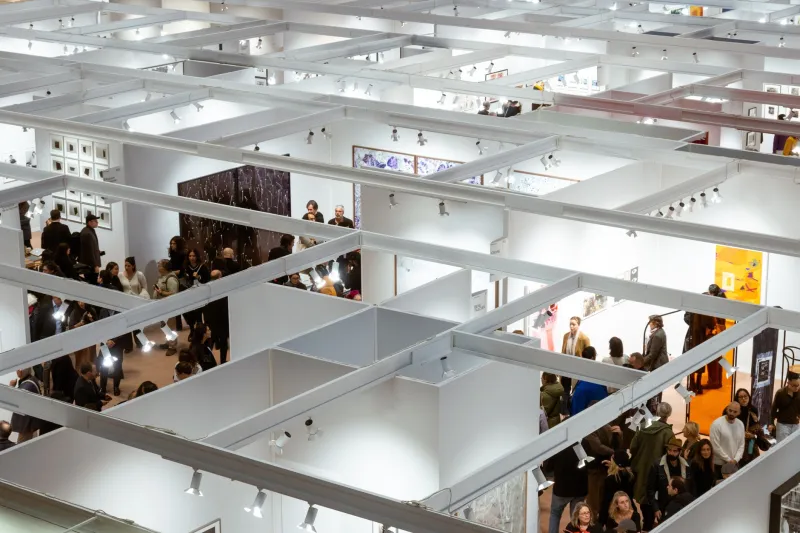
The Quiet Arbiters: What London’s Fair Crews See First

Before the first collector crosses the threshold at a London fair, the booth has already been judged by the people who built it. Riggers, registrars, lighting technicians and stand builders spend days in the same tent or hall, and their view is unusually clear: not simply whether a work is good, but whether it has been given a fair chance to be seen. Theirs is the eye that notices the shadow across a canvas, the label set too low, the wall colour that turns a warm grey into a cold one.
The first read is a shadow
'You can tell a lot from the floor before anything is hung,' says a lighting technician who has worked on several London fairs, including Frieze and Masterpiece. 'If the stand is still being painted when the crates arrive, the hang will be reactive. If the walls are finished and the lights are already focused, someone has thought about the room.' The difference is not merely professional pride. A rushed booth tends to reveal itself in small compromises: a picture light aimed at the frame rather than the surface, a plinth that catches a reflection, a gap between works that has been closed with a plant or a catalogue stand.
Registrars see the same story from the condition reports. A work that has been on the road for months may arrive with fresh scuffs, but the more revealing detail is how it is handled in the booth: whether gloves are worn, whether a painting is rested on its edge, whether the crates are stored out of the way. 'The best stands are calm backstage,' one registrar says. 'The worst are the ones where everyone is moving fast and no one is quite sure who is responsible for the screwdriver.'
Spacing, glare and the colour of the wall
The technicians’ vocabulary is practical, but it translates directly into what a viewer feels. Spacing is not just a question of centimetres; it is the rhythm of the hang. A considered stand gives each work a little air, then groups related pieces so that the eye can move without interruption. Glare is the enemy of that movement. A canvas under glass, or a photograph with a glossy surface, can be rendered almost invisible by a single ceiling spot. The fix is rarely dramatic — a diffuser, a change of angle, a lower output — but it requires someone to look from the visitor’s height rather than the installer’s ladder.
Wall colour is another signal. White is not neutral by default; it can be warm, cool, chalky or bright. A wall that is too bright can flatten a delicate drawing, while a warmer tone can make a cool-toned painting sing. 'We spend more time on wall colour than people think,' says a stand builder who works across London’s smaller fairs. 'It is the first thing the eye adjusts to, even if the visitor never notices it.'
What a considered hang looks like
The insiders I spoke to kept returning to the same small signals. A well-built stand has a clear sightline from the aisle; the labels are at a consistent height and light enough to read without bending; cables are hidden, not merely tucked; plinths are level and painted to match the wall; and there is somewhere for the eye to rest. None of this guarantees good art, but it gives good art a better chance.
It also makes the fair easier to read. When a booth is well hung, you can tell where one conversation ends and another begins. When it is not, you spend the first minute working out whether you are looking at a solo presentation, a group hang or a storage solution.
A viewer’s checklist
- Stand back before you step in. Is there a clear sightline, or is the first work blocked by a desk?
- Look for glare. Can you see the surface of the work, or only the reflection of a light?
- Check the labels. Are they at a consistent height and legible without stooping?
- Notice the edges. Are cables, crate corners and spare screws out of sight?
- Read the spacing. Does each work have room, or is the hang trying to fit too much?
- Look at the light. Is it focused on the art, or on the frame and the wall?
- Listen to the booth. A calm stand usually has a calm team.
The installers’ eye is not a substitute for your own. But it is a useful corrective to the fair’s theatre. Before you decide what you think of a work, give a moment to the room that surrounds it. The people who built that room have already told you a great deal about how seriously the exhibitor takes the encounter — and, occasionally, about how seriously they take the work itself.